Choosing the Right Avocado Tree
We offer avocado varieties selected for South Florida’s warm, humid climate, including early-, mid- and late-season trees that can extend your harvest through much of the year.
Our avocado trees are available in different sizes depending on current inventory. We serve customers throughout Parkland, Coral Springs, Coconut Creek, Boca Raton, Deerfield Beach, Pompano Beach, Fort Lauderdale and surrounding South Florida communities.

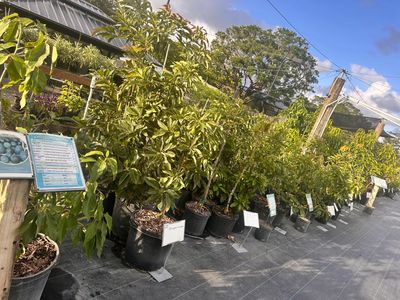
Where to start?
The best avocado tree for your yard depends on several factors, including:
- Available planting space
- Preferred harvest season
- Fruit size and flavor
- Tree growth habit
- Cold tolerance
- Flowering type
- Whether you are planting one tree or multiple trees
Some avocado trees grow very large, while others are easier to maintain at a smaller size with regular pruning. Before selecting a variety, consider how much room the tree will have at maturity and whether it can receive full sun.
Our team can help you compare available varieties and choose an avocado tree that fits your property and fruit preferences.
Choosing the right variety
Super Hass Avocado
Super Hass, also known as Ooh La La, is one of the most popular avocado trees at FloGrown Farm. It produces dark-skinned fruit with creamy flesh, rich flavor and a higher oil content than many traditional green-skinned Florida avocados.
Customers often choose Super Hass because they want an avocado with a taste and texture similar to the classic Hass avocados commonly found in grocery stores, while still selecting a tree suited for growing in a warm climate.
Super Hass trees should be planted in full sun with excellent drainage. Regular pruning can help manage the tree’s size and make harvesting easier.
Oro Negro Avocado
Oro Negro is another FloGrown Farm best seller. Its name means “black gold,” referring to its dark skin and rich, creamy flesh.
Oro Negro is especially popular with customers who prefer a flavorful, higher-oil avocado rather than the lighter, more watery texture associated with some large Florida varieties. The fruit generally has a smooth texture and excellent eating quality.
Oro Negro is a desirable choice for South Florida homeowners looking for a productive avocado tree with distinctive dark fruit.
Other Avocado Varieties for South Florida
FloGrown Farm carries a rotating selection of avocado trees suitable for South Florida. Availability and tree sizes change throughout the year.
Brogdon Avocado
Brogdon produces medium-sized fruit with smooth, dark purple skin and rich, creamy flesh. It is valued for its excellent flavor and greater cold tolerance compared with many tropical avocado varieties.
Brogdon is generally considered a Type B avocado and may be a useful pollination partner for certain Type A varieties.
Simmons Avocado
Simmons is an early-season South Florida avocado that produces large, green fruit with smooth, creamy flesh. It is a popular choice for homeowners who want avocados earlier in the season.
Simmons is generally considered a Type A avocado.
Donnie Avocado
Donnie is one of the earliest-producing Florida avocado varieties. It produces large, green fruit with a mild flavor and lower oil content than Hass-style avocados.
This variety is especially popular with customers looking for an early summer harvest.
Catalina Avocado
Catalina produces large fruit with smooth green skin and creamy, flavorful flesh. It is a popular Florida avocado with good eating quality and a productive growth habit.
Choquette Avocado
Choquette produces very large, attractive green fruit with smooth, mild flesh. It is a vigorous tree that needs adequate growing room but can be maintained with regular pruning.
Day Avocado
Day is known for its creamy texture and rich flavor. The fruit is generally smaller and denser than many traditional Florida avocado varieties.
Monroe Avocado
Monroe is a popular late-season Florida avocado. It produces large green fruit with smooth, creamy flesh and allows homeowners to enjoy avocados later in the year.
Russell Avocado
Russell is easily recognized by its long, narrow, pear-shaped fruit. It has smooth green skin and creamy flesh. Its unusual appearance makes it a favorite among tropical fruit collectors.
Wurtz Dwarf Avocado
Wurtz, sometimes called Little Cado, has a more compact growth habit than many full-sized avocado trees. It may be suitable for smaller yards when regularly pruned and maintained.
“Dwarf” does not mean the tree will remain tiny without care. Pruning is still necessary to control its size
And more.....At Flogrown Farm we are constantly cycling in new and exciting varieties like Maria Black, Winter Mexican, Marcus Pumpkin and more!
Type A & Type B Avocados
Avocado varieties are commonly classified as Type A or Type B based on the timing of their male and female flower stages.
Planting both a Type A and Type B avocado may improve pollination and fruit production. However, avocado flowering behavior can overlap considerably in South Florida’s warm climate, and a single healthy tree may still produce fruit.
For homeowners with enough space, planting two compatible varieties with similar flowering periods can increase the opportunity for cross-pollination.
Flowering times can change with weather, temperature and local growing conditions, so the A and B classification should be used as a general guide rather than a guarantee.
Where to plant your avocado tree
Avocado trees perform best in full sun. Select a location that receives at least six to eight hours of direct sunlight per day.
The planting area should also have excellent drainage. Avocado roots are sensitive to soil that remains wet for long periods.
Avoid planting an avocado tree:
- In a low area where rainwater collects
- Directly beside a downspout
- Too close to a building, fence or septic system
- Beneath dense shade from larger trees
- In an area with constant lawn irrigation
Many South Florida yards have shallow soil over limestone. Planting slightly high or creating a gently raised planting area can help protect the roots from excess moisture.
How to plant an avocado tree
Dig a hole that is wider than the root ball but not significantly deeper.
Carefully remove the tree from its container and place it so that the top of the root ball sits level with or slightly above the surrounding soil. Do not bury the trunk or place the tree too deeply.
Backfill primarily with the native soil. Water thoroughly after planting to settle the soil around the roots.
Apply mulch around the tree to help conserve moisture and reduce weeds, but keep the mulch several inches away from the trunk.
Do not create a thick mound of mulch against the bark. Constant moisture against the trunk can contribute to rot and disease.
How to fertilize
Use a fertilizer formulated for tropical fruit trees and follow the label directions carefully.
Young trees generally benefit from smaller, more frequent applications rather than one large application. Avoid placing fertilizer directly against the trunk.
Avocado trees may also benefit from micronutrients such as iron, zinc, manganese and magnesium, particularly in South Florida’s alkaline soils.
Too much fertilizer can damage the roots, burn the leaves and create excessive weak growth. More fertilizer does not always mean faster fruit production.
Pruning and maintaining tree size
Avocado trees can grow quickly in South Florida. Light, regular pruning is usually easier on the tree than allowing it to become extremely large and then cutting it back severely.
Pruning can help:
- Control tree height
- Encourage branching
- Improve sunlight penetration
- Increase airflow
- Make harvesting easier
- Keep branches away from structures
The best time to shape the tree is generally after harvest or during an active growing period when severe weather is not expected.
Avoid removing too much of the canopy at once. Newly exposed branches may become damaged by intense sun.
Common avocado tree problems
Avocado trees can be affected by root rot, fungal diseases, insects, nutrient deficiencies and storm damage.
Good tree care begins with:
- Excellent drainage
- Proper watering
- Full sun
- Adequate spacing
- Correct fertilization
- Regular observation
Leaves naturally age and fall, so occasional leaf drop does not always indicate a serious problem. Sudden widespread decline, blackened roots, severe yellowing or branch dieback may require closer evaluation.